
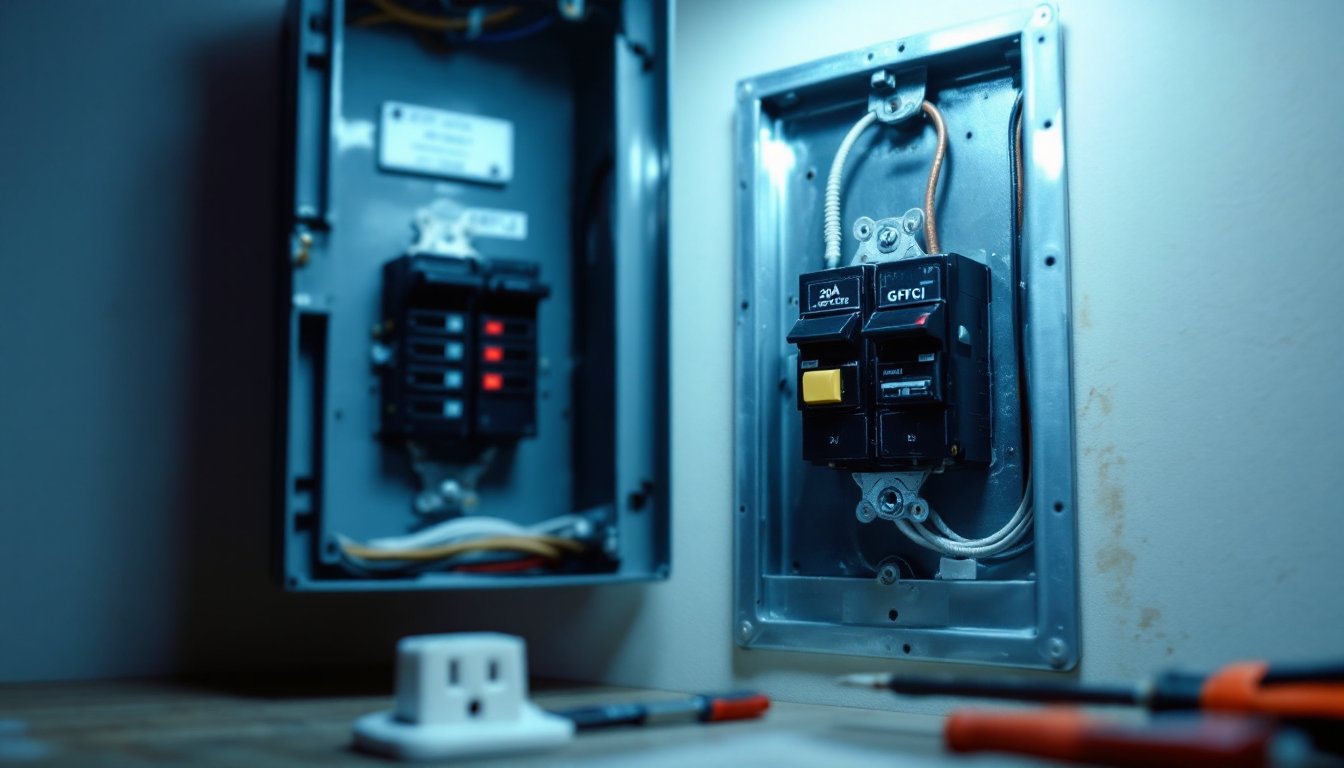
Ground fault circuit interrupters (GFCIs) prevent electrical shocks by cutting power the instant they detect a ground fault, a leak of electrical current that could flow through a person. The National Electrical Code (NEC) requires GFCI protection in wet locations like bathrooms, kitchens, garages, and outdoor spaces. But here’s where homeowners get stuck: should you install a GFCI breaker in the panel or swap out individual receptacles for GFCI outlets? Both do the same job, but the right choice depends on your circuit layout, budget, and how much of your home needs coverage. This guide breaks down how each works, where they belong, and which option makes the most sense for your project.
Table of Contents
ToggleKey Takeaways
- A GFCI breaker protects an entire circuit from the electrical panel outward, while a GFCI outlet provides protection at the point of use, making each solution ideal for different home safety needs.
- GFCI breakers cost $40–$70 each and work on 240V circuits (like hot tubs and pool equipment), whereas GFCI outlets cost $12–$25 and are limited to 120V circuits, making outlets more budget-friendly for targeted retrofits.
- The National Electrical Code (NEC) requires GFCI protection in wet locations such as bathrooms, kitchens, garages, and outdoor spaces to prevent fatal electrical shocks from ground faults.
- Choose a GFCI breaker when protecting multiple outlets on one circuit, hardwired equipment like exhaust fans, or 240V loads; opt for a GFCI outlet when retrofitting single locations, lacking panel space, or performing DIY work without opening the panel.
- GFCI outlets are easier to test and reset at eye level, while GFCI breakers require panel access but provide cleaner wall appearance and automatic protection for all downstream fixtures.
- Test your GFCIs monthly by pressing the test button to confirm power cuts, then press reset to restore function—this simple maintenance ensures your home’s shock protection system works when needed.
What Is a GFCI and Why Does Your Home Need One?
A ground fault circuit interrupter monitors the current flowing through the hot and neutral wires in a circuit. If even a tiny imbalance is detected, as little as 4-6 milliamps, the device trips and cuts power in a fraction of a second. That’s fast enough to prevent a fatal shock.
Ground faults happen when electricity finds an unintended path to ground, often through water or a person’s body. Standing on a wet bathroom floor and touching a faulty appliance creates exactly that scenario. Without GFCI protection, the current flows through you until the circuit breaker trips, which could take long enough to cause serious injury or death.
The NEC mandates GFCI protection in areas where water and electricity might meet: bathrooms, kitchens (countertop receptacles), laundry rooms, crawl spaces, unfinished basements, garages, and all outdoor outlets. Local codes may add requirements, and older homes built before these rules took effect often lack adequate protection. Retrofitting GFCI protection isn’t just about code compliance, it’s about keeping your family safe from electrocution hazards that standard breakers can’t address.
How GFCI Breakers Work and Where They’re Installed
A GFCI breaker replaces a standard circuit breaker in your main electrical panel. It looks similar to a regular breaker but includes a test button, a reset button, and a coiled white pigtail wire that connects to the neutral bus bar.
When you install a GFCI breaker, it protects every outlet, switch, and fixture downstream on that circuit. If a ground fault occurs anywhere along the line, whether at the first outlet or the last, the breaker trips and shuts down the entire circuit. You reset it at the panel, not at the point of use.
Installation requires working inside an energized electrical panel, which the NEC classifies as hazardous work. You’ll need to identify the correct circuit, remove the existing breaker, connect both the hot wire and the neutral pigtail, and ensure proper torque on terminal screws. If you’re not comfortable working with live 120V or 240V bus bars, hire a licensed electrician. Mistakes can cause arcing, panel damage, or serious injury.
GFCI breakers work especially well for circuits that serve multiple locations, a bathroom circuit feeding two or three bathrooms, for example, or an outdoor circuit with several exterior outlets. One breaker at the panel handles protection for the entire run without requiring specialized outlets at each location.
They’re also the go-to choice for 240V circuits like hot tubs, pool pumps, and some HVAC equipment, since GFCI outlets are typically rated for 120V only. Installing a GFCI breaker in these situations provides code-required protection without custom receptacles.
How GFCI Outlets Work and Where They’re Installed
A GFCI outlet (or receptacle) provides ground fault protection at the point of use. It installs in a standard electrical box and replaces a conventional duplex outlet. The face includes test and reset buttons, and the device is noticeably thicker than a standard receptacle, make sure your box has enough depth (typically a 2-inch-deep box or deeper).
GFCI outlets come with two sets of terminals: LINE (incoming power from the breaker) and LOAD (outgoing power to downstream outlets). If you connect downstream outlets to the LOAD terminals, the GFCI protects those as well. If you only use the LINE terminals, the GFCI protects just that one outlet, a common approach in kitchens where a single GFCI outlet at the start of a countertop circuit protects the rest of the counter receptacles.
Installation is straightforward for anyone comfortable with basic wiring. Turn off the circuit breaker, verify power is off with a non-contact voltage tester, remove the old outlet, and connect the wires to the appropriate terminals. White wire to LINE neutral (silver), black to LINE hot (brass), bare copper to ground. Tighten screws snugly, tuck wires into the box, and mount the GFCI.
GFCI outlets are the standard choice for retrofitting older homes. You don’t need panel access, and you can target specific problem areas, a bathroom outlet, the garage, or exterior receptacles, without rewiring entire circuits. They’re also useful in situations where only one or two outlets on a circuit need protection, such as a single kitchen island outlet on a general lighting circuit.
One limitation: GFCI outlets won’t protect hardwired equipment like bathroom exhaust fans, disposal switches, or lighting fixtures. For those, you’d need a GFCI breaker or another protection method.
Key Differences Between GFCI Breakers and Outlets
When comparing a GFCI outlet vs breaker, several practical differences affect your decision.
Cost
GFCI breakers run $40–$70 each, depending on amperage and brand. GFCI outlets cost $12–$25. If you need to protect multiple circuits, breaker costs add up quickly. Protecting six circuits with breakers could cost $300: doing the same with strategically placed outlets might cost $75.
Coverage Area
A GFCI breaker protects an entire circuit from the panel outward. A GFCI outlet protects only itself (if wired LINE-only) or itself plus downstream outlets (if wired with LOAD connections). For whole-circuit protection without multiple devices, the breaker wins.
Accessibility
GFCI outlets sit at eye level or below, making monthly testing easy. GFCI breakers require walking to the basement or garage panel. If a ground fault trips the device, resetting a breaker means leaving the room: resetting an outlet happens on the spot. That’s a practical consideration for frequently used areas.
Troubleshooting
When a GFCI outlet trips, you know exactly which receptacle or appliance caused the fault. When a breaker trips, you may have to check a dozen outlets or fixtures to find the problem. That said, nuisance tripping from moisture or aging outlets is more common with GFCI receptacles, since they’re exposed to physical wear and environmental conditions.
Installation Complexity
Swapping an outlet requires basic electrical skills and a screwdriver. Installing a breaker inside a live panel demands confidence, proper PPE (safety glasses, insulated gloves), and knowledge of panel layouts. Many jurisdictions allow homeowners to do their own breaker work, but calling a pro is the safer bet if you’re unfamiliar with panel internals.
Compatibility
GFCI breakers work on any circuit voltage (120V or 240V) and protect all device types, outlets, lights, and hardwired appliances. GFCI outlets are limited to 120V circuits and only protect plug-in loads or downstream receptacles.
When to Choose a GFCI Breaker Over an Outlet
Go with a GFCI breaker when:
- You’re protecting an entire circuit with multiple outlets. A bathroom circuit serving three bathrooms is far easier to protect with one breaker than with three or more outlets.
- The circuit includes hardwired equipment. Exhaust fans, garbage disposals, dishwashers, and sump pumps can’t plug into a GFCI outlet. A breaker covers them automatically.
- You’re dealing with 240V loads. Hot tubs, pool equipment, EV chargers, and some well pumps require 240V GFCI protection, which only a breaker can provide.
- Outlets are in hard-to-reach locations. If your exterior outlets are behind shrubs or your garage outlets are blocked by shelving, a breaker at the panel is easier to test and reset.
- You want a cleaner look. GFCI outlets with their test/reset buttons stand out on a wall. Standard outlets protected by a GFCI breaker maintain a uniform appearance.
- The electrical box is too shallow. GFCI outlets are about 1.5 inches deep: some older metal boxes won’t accommodate them. Rather than replacing boxes, a breaker solves the problem.
If you’re tackling a whole-circuit GFCI installation in your panel, work carefully and verify all connections before restoring power. Double-check that the neutral pigtail lands on the neutral bus and that the breaker is fully seated on the hot bus bar.
When to Choose a GFCI Outlet Over a Breaker
Choose a GFCI outlet when:
- You’re retrofitting one or two locations. Adding GFCI protection to a bathroom and a garage outlet? Two receptacles cost less and involve no panel work.
- You lack panel space. Older panels often run out of breaker slots. Adding GFCI outlets avoids the need for tandem breakers or panel upgrades.
- The circuit mixes protected and non-protected areas. If a circuit serves both a kitchen counter (requires GFCI) and a dining room (doesn’t), installing a GFCI outlet at the kitchen keeps the dining room on a standard receptacle. A breaker would protect everything, which works but isn’t required and could cause nuisance trips.
- You want easier resets. Frequent GFCI trips, common with certain power tools or appliances, are less annoying to reset at the outlet than by walking to the panel.
- You’re a DIYer avoiding panel work. If you’re comfortable with outlet replacement but not breaker installation, GFCI outlets are the safe choice. You can complete the job in 20 minutes with basic tools and no panel access.
- You’re troubleshooting recurring faults. When a specific outlet or appliance causes problems, isolating it with a GFCI outlet makes diagnosis easier. A whole-home protection strategy might use breakers for some circuits and outlets for problem areas.
For most DIY retrofits, GFCI outlets offer the best balance of cost, simplicity, and safety. They’re code-compliant, widely available, and don’t require opening the panel. Just remember to test them monthly, press the test button, confirm power cuts, and press reset to restore function.
Conclusion
Both GFCI breakers and outlets deliver the same life-saving shock protection, the best choice depends on your circuit layout, budget, and comfort level with electrical work. Breakers make sense for whole-circuit protection and 240V loads: outlets shine for targeted retrofits and DIY-friendly installations. Whichever you choose, you’re adding a critical safety layer that the NEC requires and that every home with water-exposed outlets needs. Test your GFCIs monthly, and if you’re unsure about any part of the installation, bring in a licensed electrician. Electrical safety isn’t the place to cut corners.